
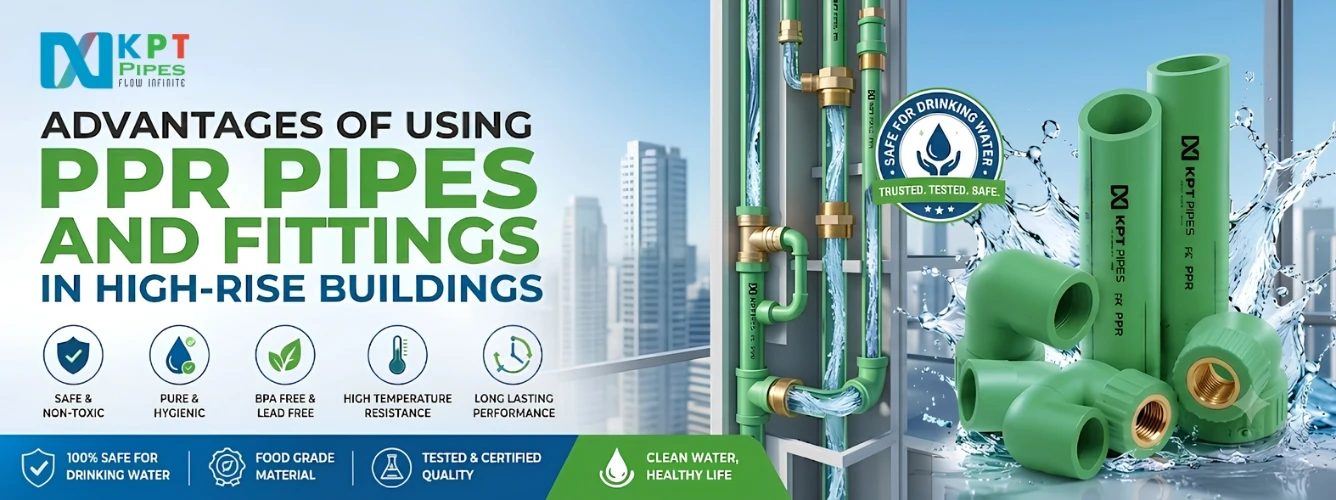
The growth of modern cities has led to an increasing number of high-rise residential towers, commercial complexes, hospitals, hotels, and mixed-use developments. These buildings require plumbing systems that can perform reliably for decades while handling constant water pressure, temperature changes, and heavy daily usage. Selecting the right pipin g material is therefore one of the most important decisions during construction.
Among the many options available today, PPR Pipes and Fittings have become a preferred choice for engineers, architects, builders, and plumbing contractors. Their excellent durability, corrosion resistance, and leak-proof jointing system make them well-suited for the demanding requirements of tall buildings. Unlike conventional piping materials that may corrode, scale, or weaken over time, PPR piping is designed to deliver consistent performance with minimal maintenance.
Table of Contents
ToggleWhy High-Rise Buildings Need Advanced Plumbing Systems
Plumbing systems in high-rise structures are more complex than those in standard residential buildings. Water must travel through multiple floors while maintaining consistent pressure and flow. The piping network also needs to withstand continuous operation without developing leaks or blockages.
A small plumbing failure in a tall building can affect dozens of apartments or offices, leading to costly repairs and inconvenience for occupants. This is why developers increasingly prefer piping materials that offer long service life, structural reliability, and easy installation.
PPR piping systems meet these expectations by combining strength with lightweight construction, making installation faster and safer without compromising quality.
Excellent Durability for Long-Term Performance
One of the biggest advantages of PPR pipes and fittings is their exceptional lifespan. When installed correctly, they can remain functional for several decades under normal operating conditions.
The material does not rust, rot, or corrode when exposed to water. Unlike metal pipes that may gradually weaken due to oxidation, PPR maintains its structural integrity even after years of continuous use.
This long service life helps building owners reduce maintenance expenses while providing residents with a dependable water supply system.
Leak-Proof Fusion Welding Technology
Leakage is one of the most common plumbing issues in multi-storey buildings. Even a minor leak can result in water damage, expensive repairs, and disruptions to occupants.
PPR pipes are connected through heat fusion welding, where the pipe and fitting become a single continuous unit. Since there are no threaded or glued joints, the possibility of leakage is significantly reduced.
This seamless connection creates a stronger pipeline capable of handling varying water pressures commonly found in high-rise buildings.
Superior Resistance to Corrosion and Scaling
Water quality varies from one location to another, and many water sources contain minerals that gradually create scale inside traditional metal pipes.
PPR material resists corrosion, chemical reactions, and mineral deposits. The smooth internal surface allows water to flow efficiently without significant obstruction over time.
Because scaling is minimized, the plumbing system continues to perform efficiently, reducing energy consumption in pumping systems and maintaining steady water pressure throughout the building.
Handles Both Hot and Cold Water Efficiently
Modern residential and commercial towers require plumbing systems that can transport both hot and cold water safely.
PPR piping is specifically designed to withstand elevated temperatures while maintaining its mechanical strength. It performs well in hot water circulation systems, central heating applications, and domestic cold water supply.
Its thermal stability makes it suitable for apartments, hotels, hospitals, educational institutions, and other facilities where temperature variations are common.
Lightweight Yet Strong Construction
Construction schedules are often tight, and installation efficiency plays a significant role in project completion.
PPR pipes are much lighter than many traditional piping materials, making transportation, handling, and installation considerably easier. Workers can move large quantities with less effort, reducing labour time and installation costs.
Despite being lightweight, the material offers impressive strength, allowing it to perform reliably under continuous operating pressure in tall buildings.
Improved Water Hygiene
Maintaining clean drinking water is a major priority in residential and commercial properties.
PPR pipes have a smooth, non-reactive inner surface that helps preserve water quality during transportation. Since the material does not corrode or release contaminants into the water, it supports hygienic water distribution throughout the building.
This makes it an excellent solution for potable water systems where cleanliness and safety are essential.
Reduced Maintenance Costs
One of the biggest concerns for property managers is the long-term maintenance of plumbing infrastructure.
Frequent repairs not only increase operational expenses but also inconvenience residents and businesses. Since PPR systems resist corrosion, leakage, and scaling, maintenance requirements remain comparatively low throughout their service life.
The reduced need for repairs helps lower lifecycle costs while improving overall building reliability.
Better Thermal Insulation
PPR naturally provides lower thermal conductivity compared to metallic piping materials.
This characteristic helps minimize heat loss in hot water systems while reducing condensation on cold water lines. Improved insulation contributes to better energy efficiency and supports more consistent water temperatures across the building.
As energy conservation becomes increasingly important in modern construction, this advantage adds long-term value.
Suitable for Various Building Applications
High-rise buildings include different plumbing requirements depending on their purpose.
PPR piping is commonly used for:
- Domestic water supply
- Hot and cold water distribution
- HVAC systems
- Chilled water lines
- Rainwater applications
- Industrial utility networks
Its versatility allows builders to use one reliable piping system across multiple applications, simplifying procurement and installation.
For projects involving Industrial Pipes and Fittings, PPR technology also provides dependable performance where corrosion resistance and long operational life are important considerations.
Similarly, many developers choose PPR solutions for Commercial Pipes because they offer durability, efficient installation, and dependable performance in office buildings, shopping centres, hotels, and healthcare facilities.
Environmentally Responsible Choice
Sustainability has become an important aspect of modern infrastructure development.
PPR pipes require relatively low maintenance, have an extended service life, and reduce material replacement over time. Their durability helps minimize construction waste generated from frequent pipe replacements.
Many green building projects prefer long-lasting plumbing systems that support efficient resource utilization throughout the building’s lifecycle.
Cost-Effective Investment
Although initial material selection is important, the overall lifetime cost of a plumbing system matters even more.
Because PPR piping reduces leakage, maintenance, corrosion-related failures, and replacement frequency, it often proves more economical over several decades of operation.
Developers, facility managers, and homeowners benefit from lower repair expenses and improved system reliability, making PPR an excellent long-term investment.
Conclusion
High-rise buildings demand plumbing systems capable of delivering reliable performance under continuous pressure, temperature fluctuations, and years of daily use. Choosing the right piping material directly affects maintenance costs, water quality, installation efficiency, and overall building performance.
PPR piping has earned its reputation by offering leak-proof joints, corrosion resistance, excellent durability, hygienic water transport, and long service life. Its ability to perform consistently in demanding environments makes it one of the most dependable solutions for modern residential and commercial construction.
As cities continue to build taller and smarter structures, PPR systems remain a practical and future-ready choice for creating efficient plumbing networks that stand the test of time.
FAQs
Q1. Why are PPR pipes suitable for high-rise buildings?
Ans: They offer high pressure resistance, leak-proof joints, and long-term durability, making them ideal for tall structures.
Q2. Can PPR pipes carry hot water?
Ans: Yes. They are designed for both hot and cold water applications and maintain strength at elevated temperatures.
Q3. Do PPR pipes rust over time?
Ans: No. PPR pipes are corrosion-resistant and do not rust like traditional metal pipes.
Q4. How long do PPR pipes typically last?
Ans: With proper installation and normal operating conditions, they can provide reliable service for several decades.
Q5. Are PPR pipes environmentally friendly?
Ans: Yes. Their long lifespan, low maintenance needs, and reduced replacement frequency make them a sustainable plumbing solution.